
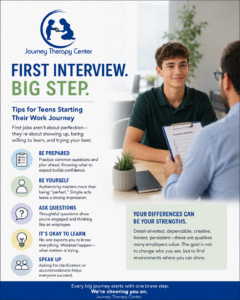
 Something exciting happened for a member of our team this week: Her teenage son, who is on the autism spectrum, landed his first summer job.
That first job interview is a big milestone for any teen. It might only be a summer position or a few shifts a week, but it’s the first real step into adulthood. The first handshake with someone outside the safety of school, sports, and family. The first time they realize they can earn their own money, solve problems, and be trusted with responsibility.
That process can feel intimidating for anyone. Even many adults still get the jitters before a job interview.
For neurodivergent teens, that pressure can feel even bigger. Unspoken social rules, unfamiliar environments, sensory overload, and anxiety about “saying the right thing” can all make the experience feel overwhelming before it even begins.
The good news is that first jobs aren’t about perfection. Employers aren’t expecting an expert. They’re usually just looking for teens who are willing to learn, show up, and try.
Before our team member took her son for his interview, they had a conversation about what might happen, and that went a long way toward increasing his confidence in an unfamiliar experience.
Most interviewers ask similar questions, such as:
“Tell me about yourself.”
“Why do you want to work here?”
“What are your strengths?”
“What hours are you available?”
Practicing answers out loud ahead of time can help reduce panic in the moment. Parents can help by casually role-playing interview questions in the car or around the dinner table. For autistic or anxious teens especially, rehearsing can make a huge difference. It helps remove the pressure of having to invent answers on the spot.
A lot of teens think interviews are about giving the “perfect” responses, but in reality, authenticity matters more than trying to perform.
Simple things such arriving on time, being polite, listening carefully, showing willingness to learn, and thanking the interviewer afterward are often enough to leave a strong impression. Teens should also know that it is perfectly acceptable to ask an employer a few questions during a job interview. A few questions our team member’s son came up with included, “What are the job responsibilities?” “Is there a uniform or a dress code?” and “What is the protocol if something goes wrong on the job?”
Thoughtful, honest questions show that a candidate is really thinking about their role as an employee.
Most of all, make sure your kid knows that it’s okay not to know everything. First jobs are for learning, and teenagers are not expected to already know how to handle every customer interaction, every register system, or every workplace situation. Employers understand this is new territory.
Mistakes will happen. Everyone has awkward first-day stories. Everyone forgets something eventually. What matters is being willing to ask questions and keep trying.
Encouraging self-advocacy is important, too. For some neurodivergent teens, small accommodations can make a huge difference, and direct communication including asking questions for clarification keeps everyone on the same page. Teens should know it is okay to ask respectful questions if something is unclear. Good workplaces appreciate communication more than silent confusion.
Also, keep in mind that your teen just might surprise you.
Too often, neurodivergent teens grow up hearing only about the things that are “hard” for them. But many traits associated with autism and ADHD can become genuine strengths in the workplace.
Some neurodivergent teens are incredibly detail oriented. Others are dependable with routines, deeply honest, creative problem-solvers, highly knowledgeable about topics they care about, or exceptionally focused once they understand a task.
Many employers value workers who notice details others miss, follow rules carefully, work consistently, think differently, and bring passion and depth to their interests. A teen who struggles socially may still be the employee who never forgets a task. A teen who feels awkward in conversation may still be the one who organizes inventory perfectly or remembers every step of a process.
The goal is not to force neurodivergent teens to become someone else. It’s to help them discover environments where their natural way of thinking can shine.
A first job interview does not need to be flawless to be successful. Sometimes the biggest victory is simply walking through the door, and just maybe that teenager comes back out grinning because they just got hired.