
 We all use our senses to experience the world around us, and sometimes, certain inputs can feel amplified, or even painful. For some autistic kids in particular, the world can feel much louder than it seems to others. Bright lights, crowded schedules, constant noise, and endless transitions can leave kids (and their parents) feeling overstimulated and exhausted before the day is even halfway through.
But relief could be waiting just outside the door.
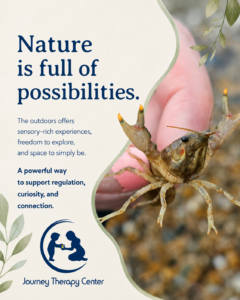
The outdoors can be one of the most naturally sensory-friendly places available to children because nature tends to offer sensory input in a gentler way. Wind shushes through the trees. Water trickles. Birds call with their different songs, but the sounds have more space to move around, so they’re not overwhelming like a busy restaurant. Even movement outside feels more free and less restricted.
Some children seek sensory input constantly. They climb, jump, spin, splash, dig, and crash into things because their bodies are craving movement and feedback. Others become overwhelmed easily and need spaces that feel less intense and demanding. Nature has a unique way of supporting both.
A child who struggles to sit still indoors may spend an hour peacefully turning over rocks near a creek or trickling mud through their fingers. A child who avoids noisy social settings might happily wander a wooded trail while talking nonstop about mushrooms, bugs, clouds, or sticks. Some children who resist structured therapy activities will naturally engage in sensory-rich experiences outside without even realizing they are “working” on regulation skills.
There is no perfect way to explore nature, either, which can remove some of the pressure many autistic children feel in highly structured environments. There is more grace to be yourself and experience the world at your own pace.
A walk doesn’t have to become a lesson, and a hike doesn’t need a destination. Sometimes success looks like noticing ants as they carry crumbs across a sidewalk or watching ripples move across a pond. That kind of intentional presence isn’t just for the little ones, either. In this world where we are constantly looking at screens and responding to demands, the slowness of nature has a way of pushing the reset button on our overstimulated adult nervous systems, too.
Outdoor sensory play can also be wonderfully inexpensive and accessible. Mud, sand, puddles, leaves, pinecones, sticks, flowers, gravel, water, and wind all provide opportunities for sensory exploration. Many children instinctively gravitate toward repetitive, calming outdoor activities like throwing stones into water, picking dandelions, filling buckets, or tracing shapes in dirt.
Parents often notice something else outdoors too: less masking.
In spaces where children are allowed to move naturally, make noise, stim freely, or focus intensely on their interests, many autistic kids visibly relax. There is less pressure to “perform” socially and more room simply to exist as they are.
Of course, every child is different, and outdoor experiences are not automatically easy for everyone. Some children may dislike bugs, unexpected noises, heat, cold, mud, or changes in routine. Others may struggle with safety awareness or wandering. Sensory-friendly outdoor exploration does not have to mean rugged hiking trips or elaborate adventures. Sometimes it simply means finding what feels good and manageable for your child.
Here are a few ideas:
- Swinging quietly in the backyard
- Blowing bubbles
- Watering plants with a hose
- Walking the same familiar trail every weekend and noticing what stays the same and what changes
- Sitting under a tree on a blanket with some books or a game
- Digging in a garden bed or sandbox
- Watching rain from a covered porch (a favorite snack is an added bonus!)
- Collecting smooth rocks or interesting sticks
- Visiting a new (or favorite) park
- Looking for frogs, birds, or insects
- Lying in the grass and watching clouds move overhead
- Making s’mores (with close supervision, of course) over a small bonfire or grill.
The goal isn’t Instagram-worthy perfection. It’s connection. (Though turning your child loose with a camera is a great way to see the world through their eyes!)
Autistic children are constantly asked to adapt to environments that overwhelm them, and the outdoors can become a place where they are finally able to exhale a little. Now that the grass is green, the flowers are blooming, and the trees are getting their leaves, it’s a perfect time to find a little peace in the Great Outdoors.