
 Adult Autism Awareness Day fell over the weekend, tucked into the middle of Autism Acceptance Month. It makes sense that it passed quietly. In some ways that reflects a larger truth: when most people think about autism, they still tend to picture children.
For a long time, the focus has been on early signs, early intervention, school supports, therapies designed to help children navigate a world that doesn’t always meet them where they are. That work matters. It changes lives, and that’s what we do here at Journey.
But it is only part of the story because those children grow up.
They become adults who are still autistic. Adults who are working, raising families, building relationships, navigating workplaces, managing households, and carrying all the complexity that comes with being human, often while also managing sensory sensitivities, communication differences, or the long-term effects of having spent years trying to fit into expectations that never quite aligned with how their brains operate.
For some, autism has been part of their identity since childhood. They were diagnosed early, and whether or not they received meaningful support, they have had time to understand themselves through that lens. Many have developed strong self-awareness, learned how to advocate for their needs, and found ways to build lives that reflect their strengths. Others have spent years studying social interactions, forcing eye contact, and suppressing natural behaviors in order to move through spaces that were never designed with them in mind. That kind of effort can be invisible from the outside, but it often comes at a cost.
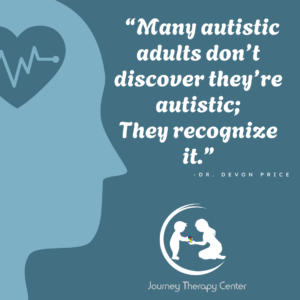
At the same time, there is a growing number of adults who are encountering autism from an entirely different starting point. These are people who were never diagnosed as children, often because there wasn’t as deep of an understanding of autism at the time, and their traits were overlooked, misunderstood, or explained away. They may have been described as shy, sensitive, intense, anxious, or “just different,” without anyone connecting those qualities to a broader neurological pattern.
For many of these adults, recognition comes later. Often it comes with their child’s diagnosis, when familiar traits start to surface in a new light. It might come through reading, through conversations, or through the slow accumulation of moments that begin to feel less like coincidence and more like a pattern. Over time, experiences that once felt disconnected start to form a clearer picture.
That process can be both clarifying and complicated. There is often a sense of relief in finally having language for lifelong experiences, in understanding certain challenges, but at the same time, there can be grief for missed support, for misunderstandings, for the energy spent trying to meet expectations that were never a natural fit.
The puzzle piece, long associated with autism, has become a point of debate in recent years, and not everyone embraces it as a symbol. Even so, the underlying idea resonates for many: the experience of something finally making sense, of scattered pieces of life coming together into a more coherent whole.
Adult autism, like childhood autism, doesn’t present in a single, uniform way. It can look like someone who thrives in structured environments but struggles with unpredictability. It can look like deep focus, creativity, and an ability to notice patterns others miss. It can look like sensory sensitivities that make everyday environments overwhelming, or a need for recovery time after social interaction, even when those interactions are meaningful and enjoyable.
It can also look like someone who has built a life that works for them, often through careful adaptation, or someone who is only beginning to realize that changes might be needed in order to feel more at ease in their own life.
Awareness, especially when it comes to adults, is less about a single day and more about an ongoing shift in understanding. It means recognizing that autism does not end at childhood, and that support, respect, and accommodation remain just as important when a person is grown. It means listening to autistic adults when they feel safe enough to share their experiences, their insights, and their perspectives on what it means to live in a world that was not always designed with them in mind.
Autism Acceptance Month offers an opportunity to see autism not just in children, but to recognize the full arc of a life including the child who grows, the adult who adapts, and the many different ways people come to understand themselves along the way.
We are doing what we can at Journey to help clear the way for the next generation, working hard to make sure our future adults look back and see a trail of support, guidance, and love stretching back over their lives.